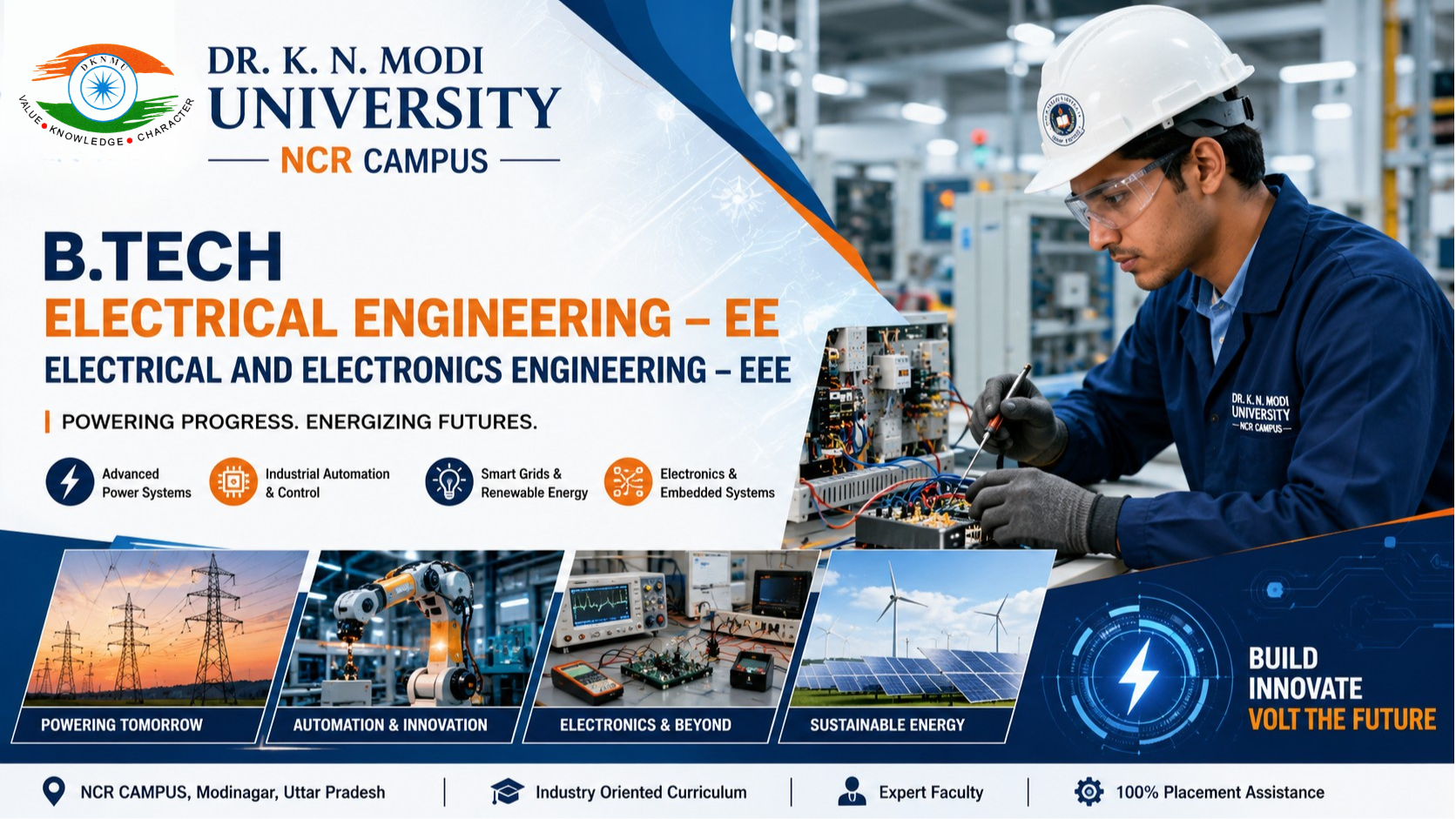
B.Tech (Electrical Engineering – EE, Electrical And Electronics Engineering - EEE)
The B.Tech in Electrical Engineering (EE) and Electrical & Electronics Engineering (EEE) at Dr. K. N. Modi University, NCR Campus is a four-year undergraduate engineering programme designed to develop highly skilled engineers for the power, electrical, electronics, renewable energy, automation, and industrial sectors. Recognized as one of the Best Engineering Colleges in Uttar Pradesh, the programme combines strong academic foundations with practical laboratory training, industry exposure, internships, and placement support.
Situated in Modinagar, Uttar Pradesh (U.P.), the university is an excellent choice for students from Ghaziabad, Meerut, Hapur, Pilkhuwa, Bulandshahr, Noida, Delhi NCR, and nearby regions seeking quality engineering education. As a leading B.Tech EE College in Modinagar and B.Tech EEE College in Ghaziabad, the university offers advanced laboratories, experienced faculty, live projects, industrial visits, and innovation-driven learning to prepare students for successful engineering careers.
Whether you are searching for an Electrical Engineering College in Uttar Pradesh, an Electrical and Electronics Engineering College in Delhi NCR, or the Best Private Engineering College in Ghaziabad, Dr. K. N. Modi University provides the perfect platform to achieve your career goals.
Why Choose B.Tech EE & EEE at Dr. K. N. Modi University?
The programme is designed according to modern industry standards with a focus on practical skills, innovation, and professional development.
Programme Highlights
- Industry-Oriented Curriculum
- Advanced Electrical & Electronics Laboratories
- Power Systems & Renewable Energy Training
- Industrial Automation & PLC Programming
- Embedded Systems & Control Engineering
- Electrical Machines Laboratory
- Smart Grid & Energy Management Concepts
- Industrial Visits & Live Projects
- Internship Opportunities
- Experienced Faculty Members
- Innovation & Research Support
- Soft Skills & Placement Training
- Modern Smart Classrooms
Programme Details
| Programme | B.Tech (Electrical Engineering – EE & Electrical and Electronics Engineering – EEE) |
|---|---|
| Duration | 4 Years |
| Programme Level | Undergraduate |
| Mode | Full-Time |
| Campus | Modinagar, Uttar Pradesh |
| Eligibility | 10+2 with Physics, Chemistry & Mathematics (PCM) as per University Norms |
Industry-Focused Curriculum
The curriculum prepares students with practical knowledge and technical expertise in electrical and electronics engineering.
Core Subjects
- Basic Electrical Engineering
- Electrical Machines
- Power Systems
- Power Electronics
- Control Systems
- Electrical Measurements
- Network Analysis
- Digital Electronics
- Analog Electronics
- Embedded Systems
- Renewable Energy Systems
- Industrial Automation
- PLC & SCADA
- Microprocessors & Microcontrollers
- Electrical Drives
- Smart Grid Technology
- High Voltage Engineering
- Industrial Training & Major Project
Advanced Laboratories
Students receive practical training in:
- Electrical Machines Laboratory
- Power Systems Laboratory
- Power Electronics Lab
- Digital Electronics Lab
- Electrical Measurements Lab
- Control Systems Lab
- PLC & Automation Lab
- Embedded Systems Lab
- Renewable Energy Laboratory
- Innovation & Research Centre
Career Opportunities After B.Tech EE & EEE
Graduates have excellent career opportunities in public and private sector organizations.
Career options include:
- Electrical Engineer
- Electronics Engineer
- Power System Engineer
- Design Engineer
- Maintenance Engineer
- Automation Engineer
- PLC Engineer
- Control Systems Engineer
- Renewable Energy Engineer
- Electrical Project Engineer
- Power Plant Engineer
- Industrial Engineer
- Field Service Engineer
- Research & Development Engineer
- Government Engineer (PSUs)
- Students can also pursue M.Tech, MBA, GATE, UPSC, and other higher education opportunities.
Placement Support
The University offers excellent placement assistance through:
- Campus Placement Drives
- Internship Programmes
- Resume Building Workshops
- Aptitude Training
- Mock Interviews
- Technical Skill Development
- Personality Development
- Industry Interaction Sessions
- Career Counselling
Modern Infrastructure
Students benefit from:
- Advanced Engineering Laboratories
- Smart Classrooms
- Innovation & Incubation Centre
- High-Speed Wi-Fi Campus
- Digital Library
- Research Facilities
- Computer Centres
- Hostel Accommodation
- Sports Complex
- Cafeteria
Admissions Open – B.Tech EE & EEE Admission 2026 -27
Applications are now open for B.Tech Electrical Engineering (EE) & Electrical and Electronics Engineering (EEE) Admission 2026 at Dr. K. N. Modi University, NCR Campus.
Students searching for a B.Tech EE College in Modinagar, B.Tech EEE College in Ghaziabad, an Engineering College near Meerut, Engineering College near Hapur, Engineering College near Pilkhuwa, Engineering College near Bulandshahr, or the Best Engineering College in Uttar Pradesh are invited to apply.
The university welcomes students from Modinagar, Ghaziabad, Meerut, Hapur, Pilkhuwa, Bulandshahr, Uttar Pradesh, U.P., Delhi NCR, and surrounding regions, offering quality education, practical training, and outstanding placement opportunities.
Quick links
- B. Sc. (Chemistry, Mathematics, Physics)
- B.A./B.A. (Liberal Arts, Psychology, English, Sociology, Economics)
- B.Design (Interior Design & Fashion Design)
- B.Lib
- B.Pharm (Bachelor of Pharmacy)
- B.Sc. (Forensic Science, Clinical Psychology)
- B.Sc. (Agriculture)
- B.Sc. (Chemistry, Botany, Zoology) CBZ
- B.Sc. Animation, VFX & Gaming, Multimedia
- B.Sc. Biotech, B.com
- B.Sc. Graphics & Web Design
- B.Sc./ BA in Sports
- B.Tech (AI & Data Science – AI & DS)
- B.Tech (Artificial Intelligence)
- B.Tech (Biotechnology)
- B.Tech (Civil Engineering)
- B.Tech (Computer Science Engineering)
- B.Tech (CSE AIML/AI)
- B.Tech (CSE Cyber Security)
- B.Tech (Electronics & Communication Engineering – ECE)
- B.Tech (Information Technology – IT)
- B.Tech (Mechanical Engineering)
- B.Tech Lateral Entry (Civil & CSE – AI)
- B.Tech Lateral Entry (Electrical Engineering – EE)
- B.Tech Lateral Entry (Mechanical Engineering)
- BA (Journalism & Mass Communication), BA Yoga
- BA.LLB, LLB
- Bachelor of Anaesthesia & Operation Theatre Technology (BAOTT)*
- Bachelor of Computer Applications (BCA)
- Bachelor of Medical Laboratory Sciences(BMLS)*
- Bachelor of Medical Radiology and Imaging Technology (BMRIT)*
- BBA